If that wagon can carry 923 pounds, at those ratios a cart could only carry 411 pounds.
What kind of trader or farmer would buy a cart that can only haul so little? If they loaded it with a single barrel of beer and sat down in its driver's seat, the thing might collapse!
That said, the Prairie Schooner you used has the lowest Empty Weight vs. Cargo Weight ratio of the vehicles whose figures are offered:
Vehicle | Empty Weight | Cargo Weight | Carry Ratio |
|---|---|---|---|
Prairie Schooner | 1,300 | 3,000 | 2.3077 |
British Army Wagon | 1,380 | 5,000 | 3.6232 |
Borax Wagon | 7,800 | 20,000 | 2.5641 |
Note that the Schooner and the Army Wagon have nearly identical weights, but the Army Wagon can carry a whole ton more. The Prairie Schooner was intended to travel for month across the wilderness without breaking down, so I suspect that the recommended 2,500 to 3,000 pound load is deliberately low to reduce the risk of damage (and put less strain on the mules).
The Borax Wagon, on the other hand was exceptionally sturdy - none of them ever broke down. So it too was likely heavier than average.
That Army Wagon, on the other hand, seems more like an "average wagon", since the Army would have lots of them in a baggage train, so it would matter less if one broke down. Since it's a 1914 or so design, it will have a metal parts such as wheel hubs, rims and axles that a D&D Wagon is unlikely to have, I'd think those would be mostly wood with some leather, rope or canvas.
I'm inclined to split the difference and use an average Carry Ratio of 3.
As for D&D carts and wagon loads, if it were up to me I'd multiple the empty weights (200 lb. cart, 400 lb. wagon) by a factor of 2.5 to 3.75, to the SRD sources and toss in some of the 2E flavour, plus a few touches of my own, to get:
Cart: This two-wheeled vehicle is usually drawn by a single horse (or other beast of burden) but can be pulled by two.It comes with a harness.
Cost: 15 gp, Weight: 500 pounds, Capacity: carries up to 1,500 pounds cargo.
Wagon: This is a four-wheeled, open vehicle for transporting heavy loads. In general, two heavy horses draw it (or other beasts of burden), but it can be hitched to anywhere from one to twelve draft animals, or maybe even more.A wagon comes with the harness needed to pull it.
Cost: 35 gp, Weight: 1,500 pounds, Capacity: carries up to 5,000 pounds cargo.
Larger and sturdier wagons are possible, but more expensive.
EDIT: I've since come across an interesting post on Axis History about "Red Army" horse-drawn carriages. The most salient section are:
Looking at Arts list of horse drawn vehicles, here is an attempt to show what each type is like and its basic characteristics. There were defined in the 1950 and 60s under the GOST scheme of standards throughout the USSR but many of these are unavailable on the internet. Horse drawn vehicles are defined by their purpose/load and the number of horses.одноконный (оглобельный) single horse or single shaft
пароконный (дышловой) pair of horses
троечный (русская тройка) three horses or Troika
четвёрочн ый(тачанки) four horses or four in hand
Carts and Gigs are two wheeled
Wagons and drays are four wheeled
There are various types of harness (the leatherwork that connects the horses to the wagon.) This is referred to in Russian as запряжек and is a complex subject but there are two groups, one which uses a 'collar' around the horses neck to connect the horse to the traces or the other type uses a breast strap usually held in place by a lightweight strap. For heavy work collars are essential but cumbersome.
Capacity or load carrying:
one horse wagons 0.75 tonne
two horse wagon 1.5 tonne
one horse cart 0.5 tonne (principally because in a two wheeled vehicle some of the weight rests on the back of the horse via the shafts.
two horse cart 0.75 tonne
one or two horse gig 0.5 tonne (carries two or four passengers)
modern steel wagons with rubber tyres on roads 2.0-2.5 tonnes
Sleighs (passengers) 400 kg
Sleds (cargo) 1000 kg
Weight of vehicle was set at 1/4 the load weight for light duty or 1/3 for heavy duty. 1/2 the load weight was deemed unacceptable (the hf.7 Stahlwagon "Horse killer" wagon in the German Army met this standard)
Sleds and sleighs 160-180kg for cargo types and 140-160kg for passenger types
Other than that there were regional variations and names but in reality these broad parameters were adhered to and this was the same as in Great Britain. So an Irish Side or "Outside" Car looked different from an English Trap or Governesses Cart but is reality they were both 4 people single horse cart frames with different bodies
So a small one-horse cart or gig would carry 500 kg or four passengers, a one-horse wagon 750 kg of cargo and a two-horse wagon 1,500 kg.
Since an average horse weighs about 500 kg, that follows the "1.5 bodyweight" rule.
Also, a "heavy duty" horse drawn vehicle weighed 1/3rd the load it could carry, a "light duty" vehicle (i.e. one unsuitable for rough terrain) could carry 1/4th.
So the Carry Ratio of 3 I suggested above corresponds to the Russian specification for a "heavy duty" vehicle.
A lightweight cart able to carry, say, 1,200 pounds would weigh about 300 pounds empty.
A lightweight wagon able to carry 4,000 pounds would weigh about 1,000 pounds.
Presumably wagons intended to carry particularly massive loads would be unlikely to be "light duty" in construction. Apart from the famous 10-ton capacity Borax Wagons, heavy wagons able to carry up to five or six tons seemed to be fairly common.
For example, the Conestoga Wagon could transport up to six tons.
Some Beer Wagons could carry up to two dozen barrels of beer, or maybe even more. Since a 36 gallon beer barrel weighs about 450 pounds, that's about 11,000 pounds or so. This picture shows a good sized "Brewer's Dray" (apparently it should be called a Horse-Drawn Trolley rather than a Dray) that appears to be carrying about 24 barrels and about twenty or so smaller casks - mostly firkins and a few kilderkins, by the look of them (see English Cask Units):
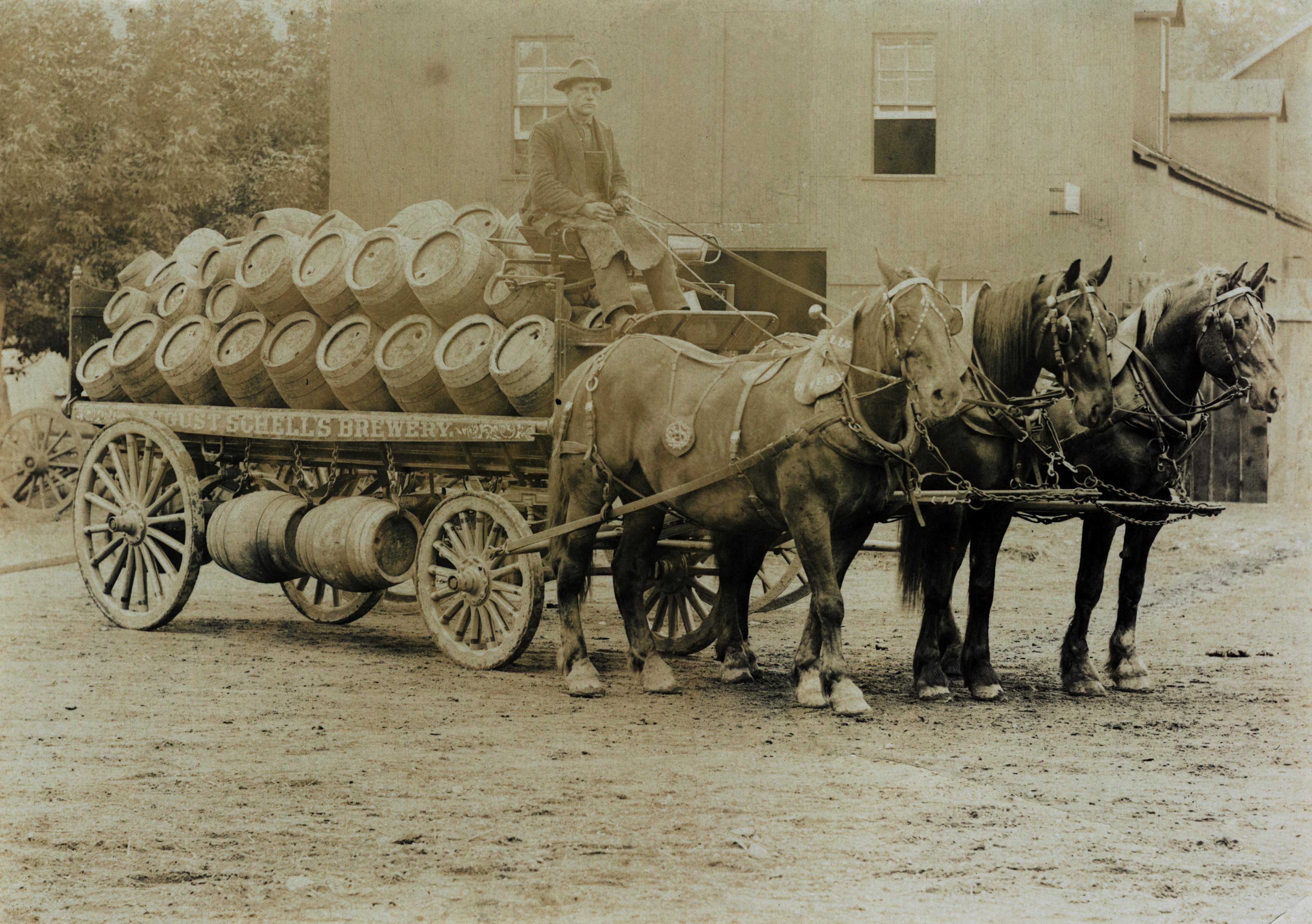
Unfortunately those barrels are obviously empty, as they have no bungs in them, so there's no concrete evidence the wagon could handle such a load. Also, note the triple-hitched horses pulling the wagon - I think that's the first time I've seen a "Troika" pulling a beer trolley.
Here's a few more pictures I stumbled upon:

Looks like ten barrels plus a couple of drivers, so 4,800 to 4,900 pounds. There are plenty of 5,000 pound wagons mentioned in catalogs and online. Note that was the load capacity of the British Army Wagon.

Obviously a modern design - note the inflatable tires and steelwork, plus the metal kegs are a bit of a giveaway! Look like maybe twenty kilderkins and at least three firkins, say twelve barrel's worth. Metal kegs are a bit lighter, but that's still about 5,000 pounds or so.

It's not all barrels! About twenty cases of stout plus a driver. So 24 pint bottles per case for maybe 55 pounds a case? It's hard to find pint bottles these days, but a 500 ml glass bottle of beer weighs 800-900g full, so including the box that sounds about right. That's only 1,100 pounds plus the driver, explaining why it only needs one horse to pull it.
ncG1vNJzZmivp6x7prrWqKmlnF6kv6h706GpnpmUqHykrdGrsKKml2KworzAnKCtsV2Wu6V51p6goKCkqHqkrdGroJ6cXZfGbsPAoKanZZ%2BneqSt0a1lb3BkZoB6ew%3D%3D